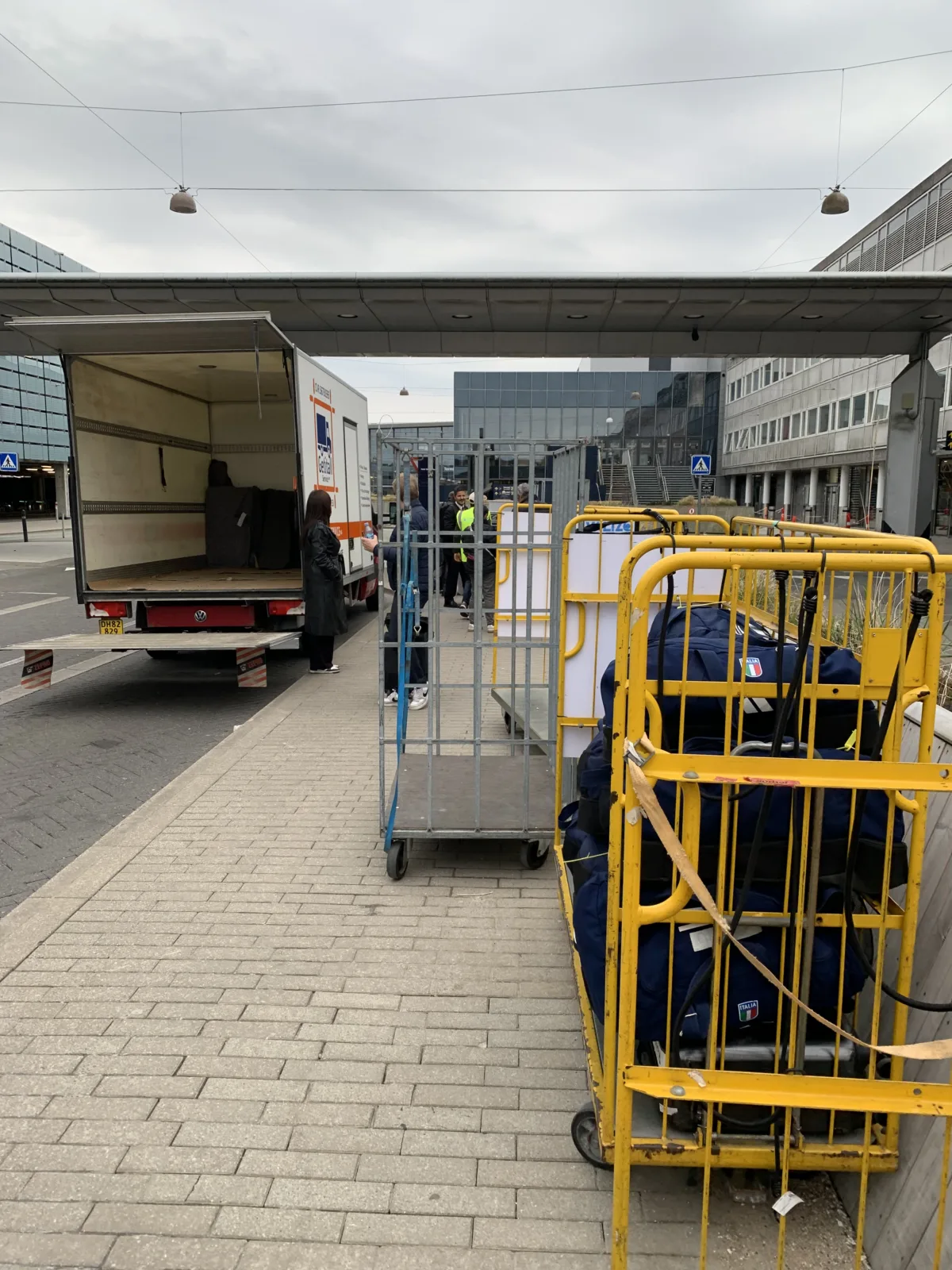
08:45 at the quayside. The tour left at 09:00.
On Friday, 24 July 2026, the expedition ship Le Champlain berthed at Nordre Toldbod in central Copenhagen, on the waterfront between Amaliehaven and Kastellet. A group of nine guests was disembarking and continuing their stay at a hotel on Rådhuspladsen.
The complication was not the distance. It is two and a half kilometers from the pier to the hotel, ten minutes in traffic. The complication was the schedule.
The guests were leaving on a rickshaw tour of the city at 09:00. Their luggage came off the ship at 08:55. That was a five-minute window in which twenty-three pieces of luggage had to change hands, be accounted for, and be released—with nine people standing on a quayside wanting to start their holiday, not supervise a bag count.
We were on site at 08:45.
Why the ten minutes before matter more than the ten minutes after
Arriving early is not politeness. It is the whole method.
A crew that arrives at the same moment as the guests is setting up while the clock runs. A crew that arrives ten minutes ahead has the vehicle positioned, the tail lift down, the manifest out, and the tags ready before the first bag appears. The handover then takes the time it actually needs, which is a few minutes, rather than the time an unprepared crew makes it take.
At Nordre Toldbod this matters more than at most locations. There is no long-stay parking on that stretch of quay. It is one of the busiest pedestrian areas in Copenhagen in high season, with the Little Mermaid, Kastellet, and Amaliehaven all within a few hundred meters. A vehicle cannot sit and wait while somebody finds a missing suitcase.
Every bag tagged by surname before it left the quay
The guest list contained two people with the same first name. On a nine-person group, that is the single most likely cause of a bag going to the wrong room.
So every tag we prepared carried the surname in large type, the first name below it, and the destination hotel. Not one bag left the quayside untagged and unrecorded.
Alongside the tags, we worked from a printed manifest: one line per guest, a column for piece count, a column for tag numbers, a column for condition on collection, and two signature blocks—one signed at the pier by the party releasing the bags and one signed at the hotel by the receiver.
That document is the difference between a professional transfer and a van with bags in it. If a question is ever raised about a piece of luggage, there is a signed record of what was collected, what condition it was in, and who accepted it at the other end. Nobody is relying on memory.
Twenty-three pieces, not eleven
The booking was placed for eleven pieces. What came off the ship were twenty-three—six backpack-sized bags and the remainder hand luggage and large travel cases.
This is normal, and it is worth being honest about why. Cruise groups are frequently booked by an operator working from a passenger count rather than a luggage count, and guests on an expedition voyage carry more than guests on a city break. The number quoted in advance and the number standing on the quay are often different.
We carried the full load and completed the transfer inside the window. Where the difference is discovered on a quayside with a tour departing in five minutes, the job is to move the luggage, not to negotiate. The commercial conversation happens afterwards, in writing, with the client.
It is also why we now ask operators for an approximate total piece count rather than a passenger count when a group booking is placed—or offer a banded rate where the count genuinely cannot be known in advance. An estimate is enough. It determines the vehicle we send, and on a longer transfer that decision cannot be corrected on the day.
One bag arrived without a tag
A small laptop bag was handed to us untagged. Our driver identified it at delivery, raised it directly with the receiver at the hotel so their staff were aware, and we sent a photograph to the operator the same morning.
Small thing. But an untagged bag that nobody mentions becomes a lost bag by the afternoon. An untagged bag that is flagged, photographed, and recorded at handover is simply a bag waiting for its owner.
What cruise and expedition operators should expect from a luggage supplier
- Arrival before the stated time, not at it. The window is set by the vessel and the excursion, not by the supplier.
- Individual tagging by surname before bags leave the collection point.
- A signed manifest at both ends, with a copy sent to the operator the same day.
- A crew that takes the whole load, whatever the count turns out to be, and settles the paperwork afterwards.
- Anything unusual reported in writing the same day — untagged items, damage noted on collection, anything that could become a question later.
- English-speaking staff, since the guests and the operator very often are not Danish.
Where we work
We handle luggage transfers across all of Copenhagen’s cruise berths—Nordre Toldbod, Langelinie Pier, Ocean Quay in Nordhavn, and Frihavnen—and to and from Copenhagen Airport, hotels, private addresses, and Airbnb properties across the city and Greater Copenhagen.
Our clients include destination management companies, inbound tour operators, cruise lines, expedition operators, and professional sports teams. We have handled the complete luggage operation for a Champions League football squad across two days and three locations, and we run regular transfers for international cycling tour groups along the Danish coast.
Group work is quoted per piece with rates that reduce with volume. Individual transfers start at DKK 795 for up to three bags. All prices exclude 25% Danish VAT.
Frequently asked questions
Can you collect luggage directly from a cruise ship in Copenhagen?
Yes, from all Copenhagen berths, including Nordre Toldbod, Langelinie, Ocean Quay, and Frihavnen. We are used to working within a vessel’s schedule and to the short handover windows that come with shore excursions.
How early do you arrive for a group collection?
At least ten minutes before the agreed handover, with the vehicle positioned and tags and manifest prepared so the handover itself takes minutes rather than the guests’ morning.
How do you make sure bags are not mixed up?
Every bag is individually tagged by surname before it leaves the collection point and recorded on a printed manifest signed at both collection and delivery. We tag by surname specifically because groups frequently contain guests sharing a first name.
What if the group has more luggage than we booked for?
We carry the full load and settle the commercial details with you afterwards in writing. We never leave luggage on a quayside. To avoid it arising, we ask for an approximate total piece count when booking or quote a banded rate where the count cannot be known in advance.
Do you provide proof of delivery?
Yes. A manifest signed at collection and again by the receiver at the destination, sent to you the same day.
What is the maximum group size you can handle?
Each vehicle carries between 10 and 100 pieces per trip, and we dispatch multiple vehicles for larger movements. We regularly handle collections of 50 to 200 pieces for cruise and conference groups.
Booking a group transfer
Email info@giaservice.dk with the vessel or flight, the berth or terminal, the date and time, the destination address, and an approximate total piece count. We confirm in writing, normally within two hours on business days.
For anything urgent, call +45 9384 1333.